

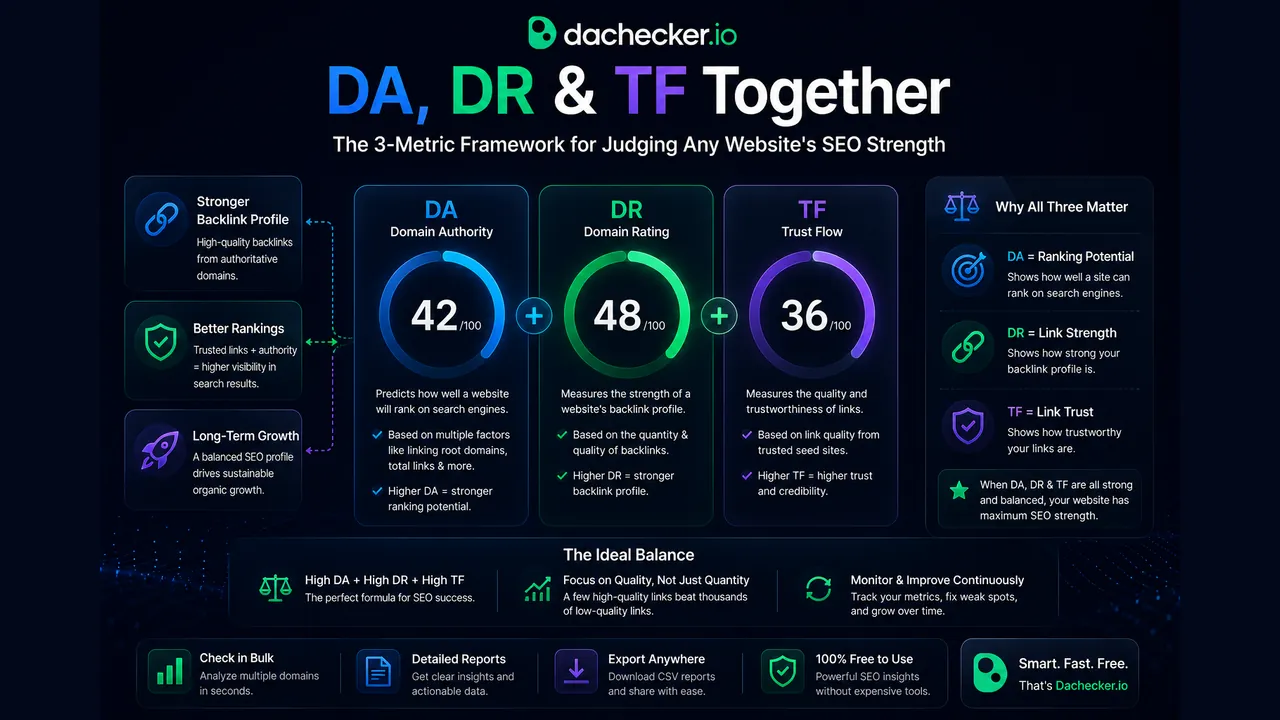
DA, DR and TF Together: The 3-Metric Framework for Judging Any Website's SEO Strength
July 16, 2026
I get some version of the same question every week: "which metric should I actually trust, DA, DR, or TF?" The honest answer is none of them alone. Each one is measuring a different slice of the same underlying reality, and reading them together tells you far more than any single score ever could. Here's the framework I actually use when I'm judging whether a website's SEO strength is real.
Why one metric alone always misleads you
Domain Authority predicts ranking potential from a blended signal set. Domain Rating measures raw link equity and volume. Trust Flow measures how trustworthy those links are based on proximity to a seed set of known-good sites. A site can score well on one of these while quietly failing on another, and that gap is usually where the real story is hiding. I've audited domains with DR in the 60s that had Trust Flow sitting at 8. That's not a strong site with a minor flaw. That's a site that accumulated a huge volume of low-quality links, probably through a PBN or expired domain network, and DR alone would never have shown you that. Trust Flow is what caught it.
The three-metric framework
Here's the practical system. Pull DA for any domain you're evaluating, whether that's a competitor, a guest post target, or your own site, using our DA checker.
Then run the same domain through our bulk DR and TF checker to get the other two metrics in one pass, and read all three in this order.
| Step | What you check | What it tells you |
|---|---|---|
| 1 | DR relative to DA | Volume of link equity versus predicted ranking strength |
| 2 | TF relative to DR | Whether that link equity is trustworthy or inflated by junk links |
| 3 | CF-to-TF ratio | A rough spam score for the link profile itself |
When all three numbers move together and sit in a similar range, that's a healthy, organically-built site. When DR is high but TF is disproportionately low, you're looking at volume without trust, a classic sign of aggressive or low-quality link building. When TF is high but DR is modest, you're often looking at a smaller, tightly-run site with a handful of genuinely excellent links, which is frequently a better guest post or partnership target than a bigger site with a bloated, low-trust profile.
Applying this to guest post vetting
This is where the framework earns its keep in practice. Before I ever pitch a guest post or accept a link exchange, I run the target domain through all three checks. A DA of 45 looks appealing on the surface, but if the TF sits at 6 and the CF-to-TF ratio is above 4, I pass every time, regardless of how good the DA number looks. That combination almost always means the site's own backlink profile is built on low-quality sources, and a link from it carries far less real value than the DA suggests, sometimes none at all if Google has already discounted that neighborhood. Conversely, I've taken guest posts on sites with a modest DA in the 20s because the TF was strong and tightly correlated with a small, clean set of referring domains. Those links moved the needle more than higher-DA placements from noisier sites.
Applying this to your own site's health check
Run the same three-step check on your own domain quarterly. If your DR has been climbing steadily from an aggressive link building push but your TF has stayed flat or dropped, that's an early warning sign worth acting on before it shows up as a ranking problem. Trust Flow tends to lag the other two metrics, since Majestic's trust distance calculation runs on its own crawl cycle, so a TF slump often surfaces issues that DA and DR haven't caught up to yet.
Where the framework breaks down
None of these metrics are perfect, and it's worth being honest about the limits. All three are third-party approximations of link-based authority, built on each company's own crawl index, which means none of them see the exact same web Google does. New, high-quality links can take weeks to show up in any of the three, and a site can genuinely be improving in Google's eyes before any external tool reflects it. Use this framework as a filter to narrow down decisions faster, not as a replacement for judgment about the actual content and relevance of a site.
Building all three metrics together
If you're trying to grow your own profile rather than just audit others, the good news is that links which move DR and DA in a healthy way, editorial placements on real, indexed sites with topical relevance, are generally the same links that move TF. There's no real tradeoff between chasing one metric over another when you're building the right way. Our DA, DR and TF boost services are structured around exactly that overlap, rather than volume tactics that inflate one number while ignoring the others.
A worked example
Say you're comparing two potential guest post targets, both showing DA 38. Site A has DR 41 and TF 33. Site B has DR 52 and TF 9. On DA alone they look identical. Once you add the other two metrics, the picture flips entirely. Site A's numbers all sit close together, which is the signature of a genuinely healthy, organically built site. Site B's DR is noticeably higher than its TF, and that gap of over 40 points is a serious warning sign, most likely a link profile inflated by low-quality volume rather than earned editorial links. I'd take the guest post on Site A without hesitation and pass on Site B even though its DA and DR both look more impressive on paper. Nine times out of ten, a link from Site A will carry more real ranking value, and it won't put my own site's trust signals at risk by association. This is the exact kind of decision the three-metric framework is built for. Any one number in isolation would have led to the wrong call here.
DA, DR and TF FAQ
- Which metric matters most for SEO?
- None in isolation. DA predicts ranking potential, DR measures link volume and equity, and TF measures link trustworthiness. Reading them together reveals patterns that any single metric misses.
- What does it mean when DR is high but TF is low?
- It usually signals a link profile built on volume rather than quality, often through PBNs, link farms, or aggressive low-quality outreach. Treat it as a red flag when evaluating that domain as a link source.
- Should I trust a site with a low DA but high TF?
- Often, yes, particularly for guest posting or partnership purposes. A smaller site with a clean, trustworthy link profile frequently passes more real value than a larger site with a noisier one.
- How often should I recheck these three metrics?
- Quarterly for your own site is reasonable. Before any guest post, link exchange, or site purchase decision, check all three fresh rather than relying on a cached or remembered number.
No single score tells the whole story about a website's SEO strength. Read DA, DR, and TF as three angles on the same question, and the gaps between them will tell you more than any one number ever could on its own.