

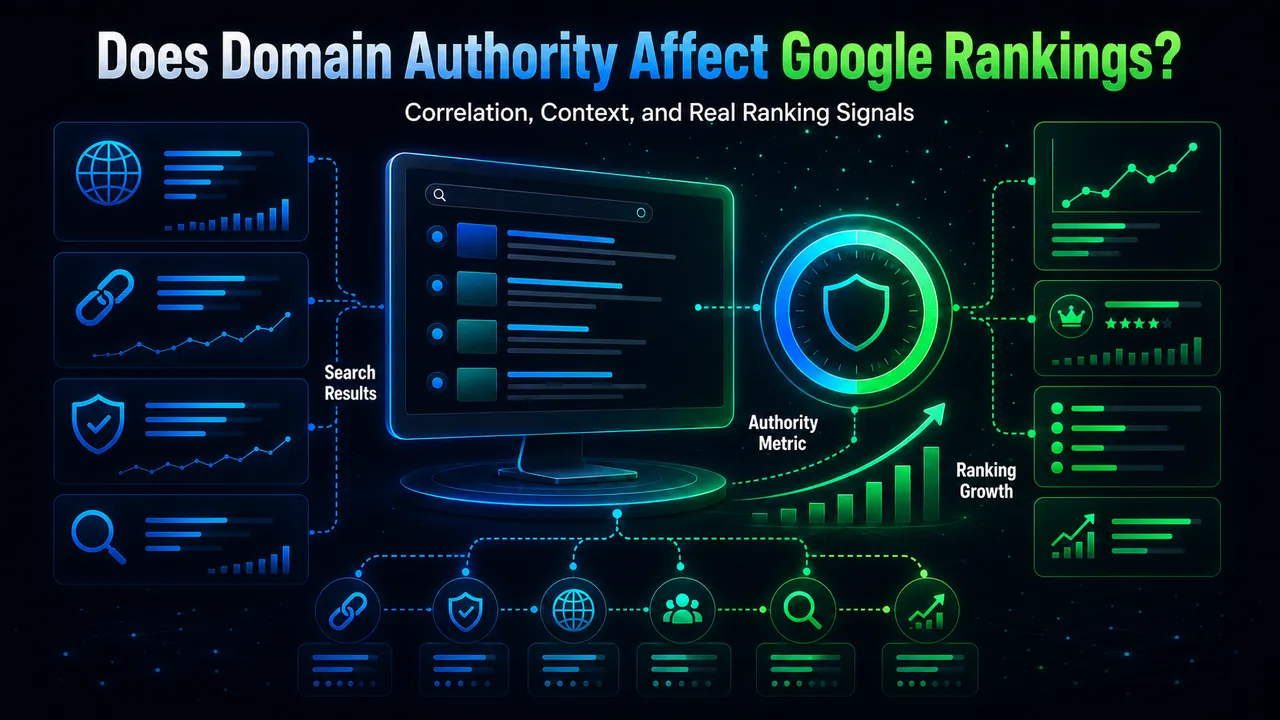
Does Domain Authority Affect Google Rankings? The Honest Answer
July 28, 2026
I get this question in almost every client kickoff call, and I understand why it's confusing. Sites with high DA tend to rank well. People trying to improve their rankings focus on building DA. The pattern looks like cause and effect. But the relationship between Domain Authority and Google rankings is more complicated than most content about it admits, and getting it wrong costs people real time and budget.
The Direct Answer
No. Domain Authority does not affect Google rankings. Moz's DA is not a Google metric, it's not part of any Google ranking algorithm, and Google has confirmed this repeatedly. DA is a Moz product, built by Moz engineers, powered by Moz's crawl of the web. Google builds and uses entirely its own internal authority systems, which are proprietary and considerably more complex than any third-party approximation.
If someone tells you that building DA will directly improve your rankings, they're confusing correlation with causation — and that confusion is genuinely expensive when it shapes a strategy.
Why High-DA Sites Tend to Rank Well
The reason high-DA sites tend to rank well is that the things that raise DA are also the things Google rewards. A site with high DA has typically earned many links from authoritative, relevant sources. Google weighs those same links — not through Moz's calculation, but through its own PageRank-derived systems. Both DA and Google rankings end up being driven by the same underlying inputs: real, quality backlinks from real sites with real traffic.
Think of it this way: a thermometer reading correlates with warm weather, but covering the thermometer doesn't make the day warmer. DA reading correlates with ranking strength, but manipulating DA directly — buying links that fool Moz's crawler temporarily — doesn't make Google rank you higher. The shared driver is genuine authority, built through genuine links over time.
What Google Actually Uses
Google's ranking algorithm is notoriously opaque, but the broad categories are well established through years of research, leaked documentation, and Google's own statements. The signals that drive Google rankings include: backlink quality and quantity through PageRank-derived systems, content relevance and topical depth, user engagement signals like click-through rate and time on page, technical quality covering crawlability and Core Web Vitals, and E-E-A-T signals around experience, expertise, authoritativeness, and trustworthiness.
None of those are DA. All of them are things that, done well, also tend to raise DA as a downstream effect. Building a proper topical content cluster — publishing pillar content and spoke articles that cover every angle of your core topic — earns links naturally and signals authority to Google while simultaneously improving your Moz Domain Authority. Not because DA helped, but because the work behind it did both things at once.
When DA Is Genuinely Useful
Despite not being a Google signal, DA is still useful as a proxy metric in the right contexts. When I'm evaluating a link prospect, I check DA to quickly filter out low-quality sites that aren't worth outreach time. When I'm assessing a new client's competitive position, I run a bulk competitor check to understand the authority landscape before recommending a link strategy. When tracking progress on a six-month link building campaign, DA movement confirms whether the effort is building the kind of authority that should eventually correlate with ranking improvements.
The mistake is treating DA as the goal rather than the indicator. I've worked with teams that optimized hard for DA — chasing the number itself through tactics that inflated the metric without building real authority — and ended up with higher DA and flat organic traffic. The metric moved but the underlying reality didn't, and Google reflects the underlying reality.
The Correlation Data Is Real, Just Misread
Multiple studies have found meaningful correlation between Moz DA and Google ranking positions. Moz's own research typically shows DA as one of the stronger correlating metrics for first-page appearances. Backlinko and Semrush have published similar correlation analyses across large keyword datasets. The correlation is real — it just isn't causal in the direction most people assume.
What these studies measure is that sites ranking on page one tend to have high DA because they've done the underlying work: earning quality links, publishing authoritative content, maintaining technical health over years. That's a useful directional insight. It just doesn't mean raising your DA score independently of that underlying work will raise your rankings. It means the work that produces high DA also tends to produce good rankings — so focus on the work, not the metric.
How to Actually Use DA in Your Strategy
Use DA as a directional indicator, not a ranking lever. Check it monthly to confirm your link building is moving the right direction. Use it to benchmark competitors so you understand what authority level you're competing against in a given keyword space. Use it to qualify link prospects during outreach — a DA 8 site with 300 "referring domains" is almost certainly a manipulated profile not worth your time.
For a complete picture of any site's real authority, I check DA alongside DR from Ahrefs and Trust Flow from Majestic. None of these tells the complete story alone. Running them together through a combined DR and TF check shows whether a site's authority is real and diverse across multiple indices, or inflated in one tool's dataset while the others show low scores — which is a reliable sign of artificial link building.
Questions About DA and Google Rankings
Will my rankings drop if my DA drops? Not necessarily. DA drops often happen during Moz's periodic index recalculations and don't always reflect changes in your actual link profile. If your referring domain count held steady and your content didn't change, a DA drop is unlikely to affect your Google rankings. Check Search Console traffic data first before assuming the worst.
Should I disavow links to protect my DA? Disavow links if you have reason to believe they represent a genuine Google manual action risk — which is rare and almost always accompanied by an actual notification in Search Console. Don't disavow links just because they're dragging down your DA. DA and Google's spam assessment are different systems with different data and different thresholds.
My competitor has DA 20 and outranks my DA 45 site. How is that possible? Content relevance, page-level authority, and precise keyword targeting can all outweigh domain-level authority on specific queries. Check what keyword the competitor is targeting, how comprehensive and useful their content is, and whether they have strong links pointing specifically to that URL rather than just their homepage. You can check links to that exact URL for free. Google's ranking is a page-level decision — Domain Authority is a domain-level signal, and that mismatch explains most cases like this.
Does Google use any Moz data? No. Google builds its own web index and ranking signals entirely independently. There is no data sharing or partnership between Moz and Google's ranking systems. They are separate companies with separate indices built from separate crawls of the web.
If DA doesn't affect rankings, why does everyone talk about it? Because it's a convenient shorthand for link profile strength, it's easy to track and report on, and it does genuinely correlate with ranking performance even if the causation runs through underlying link quality rather than through the DA metric itself. It's a useful proxy as long as you understand what it's actually measuring — and what it isn't. Use Ahrefs DR alongside it for a second opinion on any site you're seriously evaluating.