

Duplicate Backlinks Are Killing Your Link Profile: How to Find and Remove Them
July 18, 2026
I once pulled a client's backlink report and saw four hundred referring links. Sounded great until I deduplicated by root domain and found it was actually thirty-one real sites, with one sitewide footer link firing across every page of a network the client didn't even know they'd been added to. Their real link profile was a fraction of what the raw count suggested, and worse, that footer network was dragging their trust signals down. Duplicate backlinks aren't just noise. They actively hurt you in ways most people don't realize.
What counts as a duplicate backlink
A duplicate backlink isn't just the exact same URL linking to you twice. It's any pattern where a single referring domain contributes a disproportionate share of your total link count, usually through sitewide placements like footer links, sidebar widgets, author bio boxes repeated across a blog, or link exchange agreements that fire the same link on every page. Ten links from one domain's sitewide footer aren't ten times more valuable than one link from that domain. In most cases, they're worth barely more than the single link, because Google's algorithms are built to detect and discount this exact pattern.
Why duplicates actively hurt, not just fail to help
This is the part people underestimate. Duplicate and templated links don't just sit there neutrally. They inflate your perceived link count in a way that can make your profile look artificially manipulated when a real editor or algorithm examines the pattern. A profile where sixty links come from four domains, each firing a sitewide template link, looks fundamentally different from a profile where sixty links come from sixty different domains through genuine editorial placements, even though the raw numbers look similar on the surface. I've also seen this directly suppress Trust Flow. Because TF weighs link diversity and genuine seed proximity, a profile stuffed with templated duplicates from a small number of domains tends to score lower on TF than a smaller, cleaner profile would. You can check this yourself by running your referring domains through our bulk DR and TF checker and comparing your total backlink count against your unique referring domain count. A big gap between those two numbers is the first sign of a duplication problem.
How to actually find them
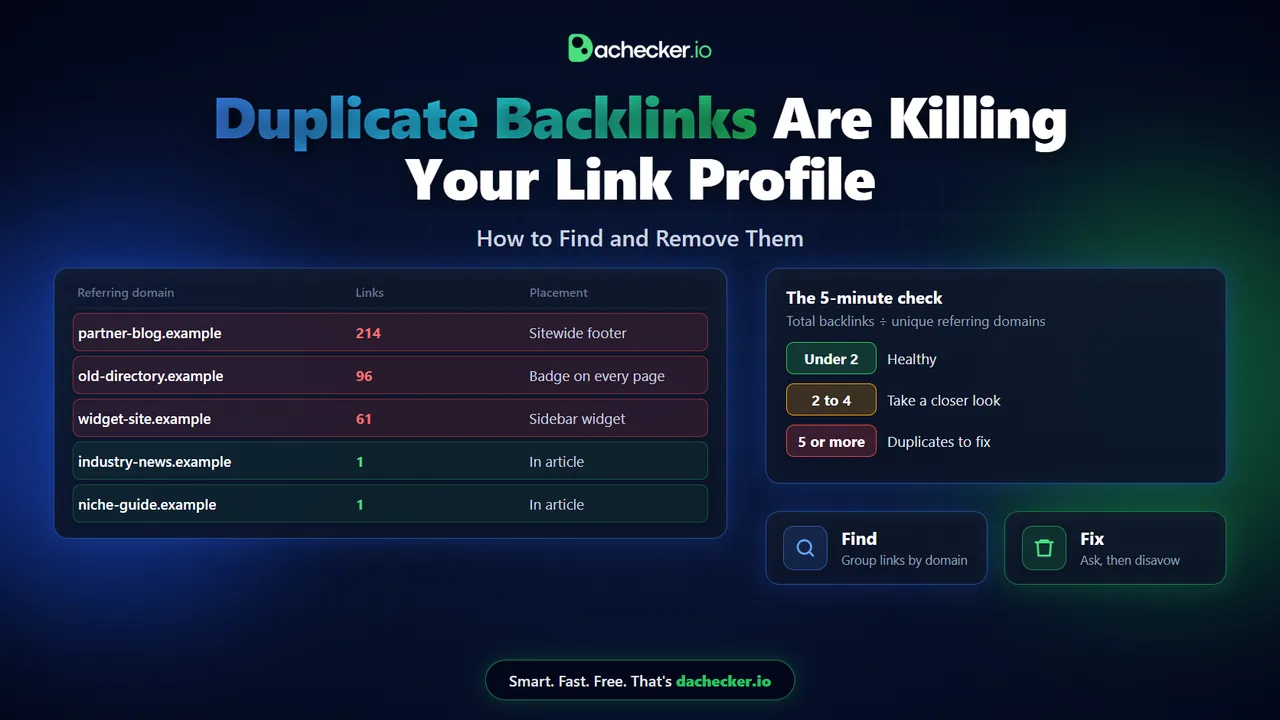
Start with a full export of your backlinks from Google Search Console, which lists both linking pages and linking sites separately. Sort by linking site and count how many individual pages from each domain link to you. Any domain contributing more than five or six links, especially if the anchor text or placement looks identical across them, needs a manual look. Cross-reference this against a bulk check of DR and TF for those specific domains. Low trust combined with high link volume from a single source is the clearest signature of a duplicate or templated link pattern rather than genuine editorial coverage.
Removing duplicates that hurt you
Reach out to the site owner directly and ask them to remove or reduce the sitewide placement, especially if it came from an old directory listing, widget, or badge you no longer use. Most site owners will comply, particularly for outdated partnership links or old guest post author boxes with excessive self-links. For links you can't get removed through direct outreach, and that show a genuinely spammy, manipulative pattern rather than just an outdated partnership, a disavow file through Google Search Console is the fallback option. I'd still caution against disavowing every duplicate you find. Google's algorithms are generally competent at discounting templated sitewide links on their own without penalizing you for having them. Reserve disavow for cases where the pattern looks deliberately manipulative, not just administratively messy.
Preventing new duplicates from forming
The most common source of new duplicate links I see is directory and badge submissions, where a site owner adds your logo or a "proudly hosted by" style link to every page of their site through a shared template. Before accepting any link placement offer, ask specifically whether the link will appear on one page or sitewide. A single contextual link inside a relevant article is worth more to your profile than a sitewide badge link, even though the badge technically generates more raw link count. If you're actively building links rather than just auditing existing ones, prioritize placements that guarantee single-page, contextual link insertion. Our DA, DR and TF boost services are structured this way specifically to avoid contributing to the kind of duplicate, templated pattern that ends up working against you.
The diversity metric that actually matters
If you take one number away from this article, make it unique referring domains, not total backlinks. A site with forty links from forty different domains has a fundamentally stronger, more defensible link profile than a site with two hundred links concentrated in fifteen domains, even though the second number looks more impressive at a glance. Every audit I run starts by calculating that ratio, because it tells you more about real link health than almost any other single check. Our free backlinks checker shows both numbers, total backlinks and referring domains, for any site.
A quick gut-check calculation
Here's a rough heuristic I use in the first five minutes of any audit, before doing anything else. Divide your total backlink count by your unique referring domain count. A ratio under 2 is generally healthy, meaning most domains link to you once or twice. A ratio between 2 and 4 is worth a closer look but not automatically alarming, since some genuine sites do link to you from multiple relevant pages over time. A ratio above 5 or 6 almost always means a small number of domains are firing a disproportionate share of your links, and that's exactly the pattern to dig into first. I ran this calculation for a client last year and got a ratio of 9. Total backlinks looked healthy at 540, but unique referring domains were only 60. Digging in, three domains alone accounted for over 200 of those links through old directory badge placements the client had forgotten they'd ever signed up for. Removing two of the three and keeping the one with genuine relevance and decent Trust Flow brought the profile back to a much cleaner, more defensible shape, and their unique-domain count became a far more accurate reflection of their actual link building progress going forward.
Duplicate backlinks FAQ
- Do sitewide footer links count as multiple backlinks?
- Technically yes in a raw crawl count, but Google's algorithms are built to detect and discount this pattern, treating it closer to a single link in terms of real value passed.
- Should I disavow every duplicate link I find?
- No. Reserve disavow for genuinely spammy or manipulative-looking duplicate patterns. For outdated partnership or badge links, direct outreach asking for removal is usually more effective and less risky.
- What ratio of unique domains to total backlinks is healthy?
- There's no universal number, but a large gap, for example two hundred backlinks from only fifteen unique domains, is a strong signal of duplication that's worth investigating.
- Can duplicate backlinks lower my Trust Flow?
- Yes. A profile concentrated in a small number of domains, especially low-trust ones, tends to score lower on Trust Flow than a more diverse profile of similar total size.
Raw backlink count is one of the most misleading numbers in SEO when it's inflated by duplicates. Check your unique referring domain ratio before you celebrate a big link count, and clean up sitewide templated links before they quietly work against the profile you're trying to build.