

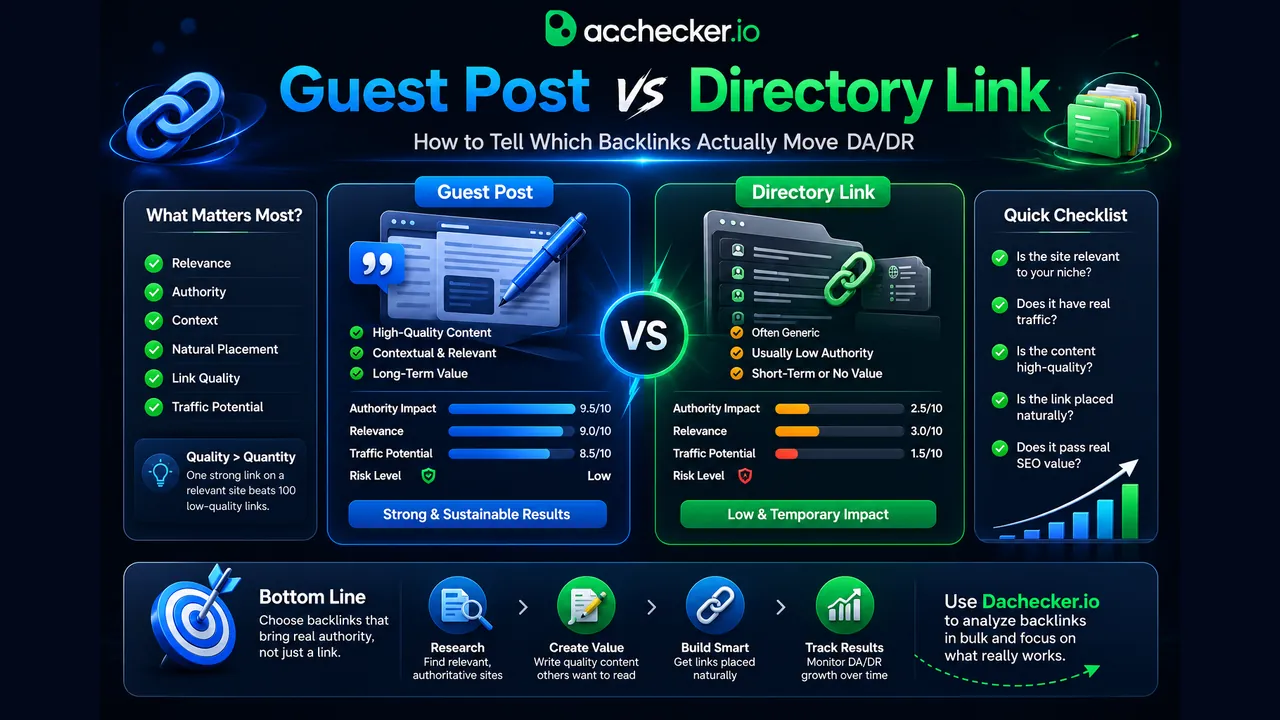
Guest Post or Directory Link? How to Tell Which Backlinks Actually Move DA/DR
July 22, 2026
Someone offers you a guest post for two hundred dollars. Someone else offers you a directory listing for twenty. On paper the directory looks like the obvious value play, ten times cheaper for what looks like the same outcome, a link. In practice these two link types behave completely differently for DA and DR, and treating them as interchangeable is one of the more expensive mistakes I see people make when building a link budget.
What actually differs between the two
A guest post is a contextual, editorial link embedded inside relevant content, ideally on a site with real topical overlap to yours, placed there because an editor decided it added value to the piece. A directory link is a listing, your business name and URL sitting in a structured database alongside hundreds or thousands of other listings, with little to no contextual relevance beyond the category you're filed under. Google's algorithms weigh editorial context heavily. A link surrounded by relevant, genuinely useful content signals something fundamentally different than a link sitting in a list of unrelated businesses. This isn't a minor nuance, it's close to the core distinction between what Google considers an earned endorsement versus a submitted listing.
How this shows up in the metrics
Run both link types through our bulk DR and TF checker against the domains hosting them and you'll usually see the pattern immediately. High-quality guest post sites tend to carry a healthier Trust Flow relative to their Citation Flow, because their own link profile is built from genuine editorial coverage rather than volume. Directory sites, especially the lower-tier ones that accept nearly any submission for a fee, often show a much wider CF-to-TF gap, since their own backlink profile is frequently padded with reciprocal or low-quality links from other directories in the same network. That gap matters because link equity passes through the linking domain's own trust signals. A link from a directory with a bloated, low-trust profile passes proportionally less value than a link from a smaller, cleaner guest post site, even if the directory shows a higher raw DA on the surface.
Not all directories are bad, and not all guest posts are good
I want to be fair here, because this isn't a blanket rule. Industry-specific, curated directories with genuine editorial review, think established professional associations or vetted local business directories, can carry real value and legitimate trust. The distinction isn't "directory bad, guest post good." It's "curated and relevant good, mass-submission and generic bad," and that applies to both categories. Similarly, plenty of guest posts are worthless. A guest post on a site that publishes fifty low-effort articles a day for anyone willing to pay isn't meaningfully different from a spammy directory. It's still a paid, low-effort placement with no real editorial standard behind it, just wearing a different format.
The questions I actually ask before paying for either
- Does this site have genuine organic traffic, or does it exist purely to sell placements? Check this with a quick look at estimated traffic trends, not just DA
- Is the site's own TF-to-CF ratio healthy, or does it show signs of a low-quality link network?
- Would a real reader in my niche plausibly find and click this link in context?
- Is the placement permanent, or does it disappear after a few months, which some cheaper directory and guest post networks quietly do?
If a placement, guest post or directory, fails two or more of these questions, I pass regardless of the price.
What moves DA and DR faster, in practice
Based on tracking outcomes across client campaigns, a small number of well-placed contextual guest posts on relevant, trustworthy sites consistently outperforms a large number of directory submissions for both DA and DR growth. The directories aren't worthless, they contribute some baseline link diversity and occasionally send real referral traffic, but treating them as your primary strategy tends to produce a link profile that plateaus quickly and shows the CF-to-TF gap warning signs we've covered in our Trust Flow guide. If you're building a link budget from scratch, I'd allocate the majority toward a smaller number of genuinely relevant editorial placements and treat directory submissions as a minor supplementary tactic, not the core of the strategy.
Building a link profile that reflects this
This is the exact framework behind how we structure our own DA and DR boost services: real editorial placements on relevant, indexed sites rather than bulk directory submissions or link farm volume tactics. It costs more per link than a directory submission, but the DA and DR movement per dollar spent is consistently better, and the profile holds up under scrutiny in a way volume tactics don't.
A side-by-side comparison from actual link offers
I recently evaluated two link offers for the same client in the same week. One was a directory submission package, fifteen listings for sixty dollars total, across a mix of general business directories. The other was a single guest post on a mid-sized industry blog for one hundred fifty dollars. Running both through a bulk DR and TF check told the real story. The fifteen directories averaged DA 24, but their TF-to-CF ratio showed most of them padded with reciprocal directory-to-directory links, and traffic estimates for all fifteen combined were close to zero, meaning no real audience would ever see or click these listings. The single guest post site showed DA 31, a healthy TF close to its CF, and consistent monthly organic traffic in the low thousands, meaning actual readers in the client's industry would see that link in context. We skipped the directory package entirely and took the single guest post instead. Three months later, the client's DR had moved more from that one contextual placement than it likely would have from all fifteen directory listings combined, and unlike the directories, the guest post also sent a handful of real referral visits directly from readers who clicked through, something a directory listing buried in a list almost never does.
Guest posts vs directories FAQ
- Are directory links worthless for SEO?
- Not entirely. Curated, relevant directories with real editorial standards can add value. Mass-submission directories with little relevance or review carry far less value and can even signal low quality if they dominate your link profile.
- Are guest posts always better than directory links?
- Not automatically. A low-effort guest post on a site that publishes anything for a fee offers little more value than a generic directory listing. The quality and relevance of the host site matters more than the format.
- How do I check if a guest post site is worth paying for?
- Check its DR, DA, and TF together, look at whether it has genuine organic traffic, and confirm the placement is permanent rather than removed after a few months.
- What's a healthy ratio of guest posts to directory links in a link profile?
- There's no fixed ratio, but weighting your budget toward relevant editorial placements over bulk directory submissions consistently produces stronger, more durable DA and DR growth.
Price per link is the wrong way to compare a guest post against a directory listing. Judge both by the same standard: is this a genuine editorial context a real reader would encounter, hosted on a domain with trustworthy signals of its own. Everything else is secondary.