

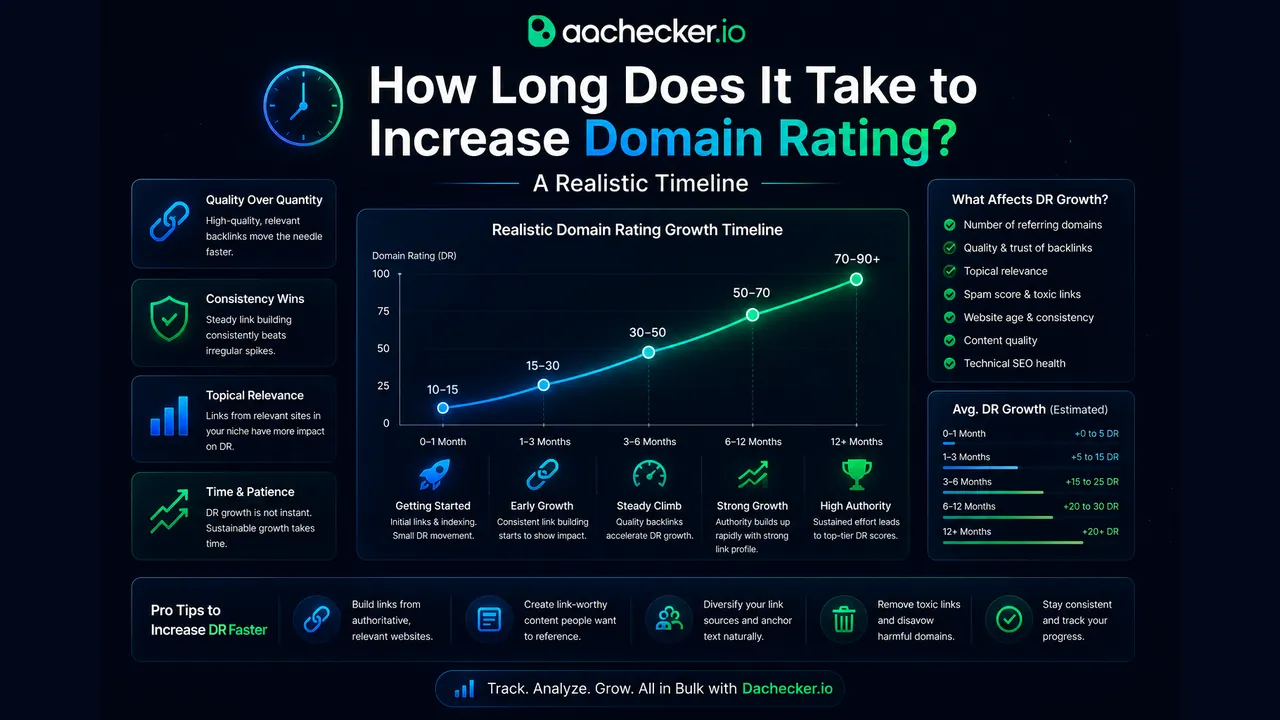
How Long Does It Take to Increase Domain Rating? A Realistic Timeline
July 20, 2026
"How fast can you increase my DR" is one of the first questions almost every prospective client asks, and I understand why. It's also the question I'm most careful about answering honestly, because the real timeline depends on where you're starting from and what kind of links you're willing to build. Here's the actual, realistic breakdown based on what I've seen across dozens of campaigns.
Why there's no single answer
Domain Rating moves based on the quantity and quality of referring domains linking to you, weighted by those domains' own DR and how they distribute link equity across their outbound links. A site starting at DR 10 can often reach DR 25 to 30 within two to three months with a focused campaign, because there's a lot of low-hanging fruit at that range. A site starting at DR 50 trying to reach DR 60 is a completely different project, often taking six months or longer, because Ahrefs' scoring is logarithmic and each additional point at the higher end requires disproportionately more link equity than the last. You can track this yourself over time using our bulk DR checker, checking monthly rather than weekly, since week-to-week noise from Ahrefs' own index updates can be misleading.
Realistic timelines by starting point
| Starting DR | Target | Realistic timeline | Why |
|---|---|---|---|
| 0-15 | +15-20 points | 6-10 weeks | Low competition for early link equity, fast wins available |
| 15-35 | +10-15 points | 2-4 months | Needs more targeted, higher-DR link sources |
| 35-55 | +10 points | 4-6 months | Diminishing returns kick in, requires better quality per link |
| 55+ | +5-10 points | 6-12 months | Only high-DR, highly relevant links move the needle meaningfully |
These ranges assume a consistent, ongoing link building effort, not a one-time burst. A single month of aggressive outreach followed by six months of nothing produces a much slower, choppier result than a steady drip of quality links spread across the same period.
The three factors that actually control your timeline
First, your current DR relative to your niche competitors. If you're already close to the top of your competitive set, further gains slow down naturally because there are fewer higher-DR domains left to realistically target for links. Second, the DR of the domains you're able to earn links from. A single link from a DR 70 site can move your score more than ten links from DR 15 sites combined. This is why quality-focused campaigns often outperform volume-focused ones even on a pure DR basis, not just on safety. Third, and most overlooked, how quickly Ahrefs actually crawls and indexes your new links. There's a lag between a link going live and it showing up in Ahrefs' index, sometimes two to six weeks depending on how frequently Ahrefs crawls the linking domain. If you built ten links last week and your DR hasn't moved yet, that's often just the crawl lag, not a sign the links didn't work.
Why "buy your way to DR 50 in a month" offers are a trap
I see these offers constantly, and I understand the appeal when a client wants fast results. The mechanism behind a rapid DR spike is almost always the same: a large batch of low-quality or PBN links fired at once. This can genuinely move DR fast, because Ahrefs' algorithm doesn't distinguish link quality the way Trust Flow does. But it leaves you with a link profile that has high DR and low Trust Flow, exactly the mismatch pattern that signals a manipulated profile to anyone auditing it, including Google over time. I've had to help clients recover from exactly this after a previous agency promised a fast DR jump. The recovery took longer than building it properly the first time would have.
How seasonality affects your timeline
One factor that rarely gets mentioned: outreach response rates and link placement speed both slow down noticeably around major holiday periods, particularly the last few weeks of the year, when editors and site owners are slower to respond to pitches and content calendars fill up. If your campaign spans that window, build in an extra few weeks of buffer rather than assuming the same pace you saw in a normal month. I've had campaigns that were tracking ahead of schedule in October slow to a crawl in December purely because response times doubled, then pick back up in January once everyone returned to a normal work cadence.
What actually speeds up a legitimate timeline
You can accelerate the realistic ranges above, but only through means that don't compromise link quality:
- Prioritizing higher-DR link sources over a larger volume of lower-DR ones
- Running outreach and content promotion in parallel rather than sequentially
- Building relationships with a handful of publishers who'll link to you repeatedly over time, rather than one-off placements you have to re-earn from scratch each month
- Making sure your own site has genuinely link-worthy content, since even great outreach struggles to place links to a page that isn't worth linking to
If you want a structured, done-for-you version of this that skips the months of cold outreach and relationship building, our DR boost service is built around exactly this approach: consistent, quality-first link placements delivered on a realistic schedule rather than a risky fast spike.
A timeline from a real campaign
One client came to me at DR 22, a two-year-old site with a handful of decent links but no real ongoing outreach. We set expectations at DR 35 within four months, based on the ranges above, and ran a steady campaign of roughly six to eight quality placements a month rather than one large batch. By month two we'd only moved to DR 26, which felt slow and prompted a nervous call from the client. By month four we'd hit DR 34, just short of target, and by month five, once the crawl lag caught up on the final round of links, we landed at DR 37, ahead of the original goal. The lesson from that project, and one I repeat to every new client now, is that DR growth is backloaded, not linear. Early months show smaller gains than people expect because of crawl lag, then the trend accelerates as more links get indexed and Ahrefs' model has more data to work with. Judging a campaign's success at the two-month mark, before the crawl lag has caught up, is the single most common reason clients think a legitimate campaign isn't working when it actually is.
Domain Rating timeline FAQ
- How fast can I increase my Domain Rating?
- It depends heavily on your starting point. Lower DR sites can gain 15-20 points in under three months, while sites already above DR 50 typically need six months or more for smaller, harder-earned gains.
- Why hasn't my DR changed after building new links?
- Ahrefs takes time to crawl and index new links, sometimes several weeks depending on how often it crawls the linking domain. Check again after a full month before assuming the links didn't work.
- Is it possible to increase DR quickly and safely?
- Fast DR jumps are usually achieved through low-quality link volume, which creates a mismatch with your Trust Flow score and other trust signals. Sustainable growth is slower but far less risky.
- Does DR growth slow down at higher scores?
- Yes, because Ahrefs' scale is logarithmic. Each additional point at DR 60+ requires significantly more link equity than the same point gain did at DR 20.
There's no shortcut that doesn't come with a hidden cost. Set your DR growth expectations based on your actual starting point, track progress monthly rather than weekly, and prioritize link quality over speed if you want gains that hold up under scrutiny.