

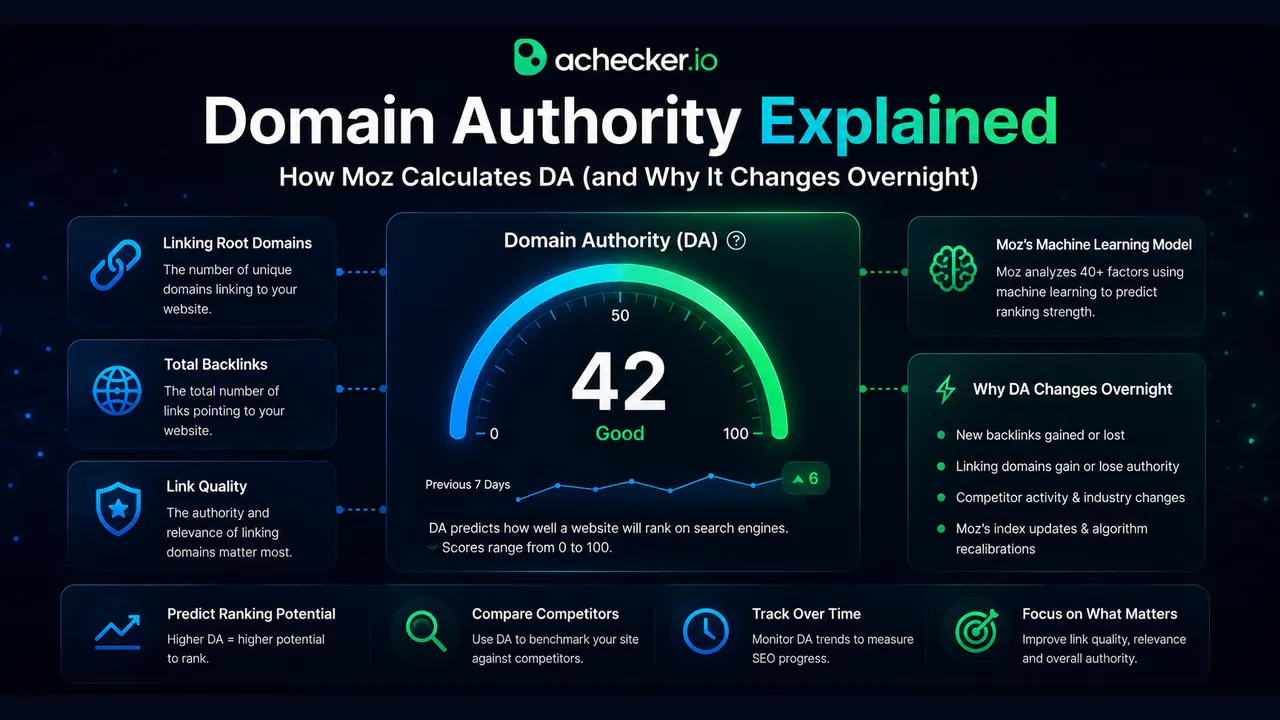
How Moz Calculates DA and Why It Changes Overnight
July 12, 2026
Domain Authority is the metric everyone quotes and almost nobody understands correctly. I've had clients panic because their DA dropped three points overnight, then celebrate a month later when it jumped five points for no reason they could point to. Neither reaction made sense once I explained what Moz is actually calculating and how often that calculation changes. Here's the real mechanics behind the number.
What Domain Authority is actually built from
Domain Authority is a machine learning model built by Moz that predicts how well a website is likely to rank in Google's search results, scored from 1 to 100 on a logarithmic scale. It isn't a single measurement. It's a composite prediction trained on dozens of ranking-correlated signals, primarily the quantity and quality of linking root domains, but also link diversity, spam signals, and Moz's own crawl data from its Link Explorer index.
The logarithmic part matters more than most guides admit. Moving from DA 20 to DA 30 takes a meaningfully smaller effort than moving from DA 70 to DA 80. At the low end you're competing against sites with almost no link equity. At the high end you're competing against sites that have accumulated years of authoritative links, and each additional point requires disproportionately more link equity to earn. If you're stuck at DA 35 and it feels like your last ten links did nothing, that's expected, not a sign you're doing something wrong.
You can check DA and PA for any domain instantly with our DA and PA checker, which pulls Moz's live index data rather than a cached snapshot.
Why your DA changes without you doing anything
This is the part that confuses people the most. Moz recalculates its entire link index and re-trains the DA model on a rolling basis, not the moment a new link appears. When Moz refreshes its index, every domain in existence gets rescored relative to every other domain, because DA is a relative, competitive metric, not an absolute one. If a huge number of new domains entered the index with strong links, your DA can drop slightly even though nothing about your own site changed. You didn't lose authority. The scale under you shifted. I've seen this catch out agencies who report DA month over month to clients without explaining this mechanic, and it creates unnecessary panic. A two or three point swing with no link losses on your end is almost always an index refresh, not a real problem.
The difference between DA and Page Authority
Domain Authority scores the whole domain. Page Authority (PA) scores a single URL using the same underlying model and signal set, just applied at the page level instead of the domain level. A domain can have a strong overall DA while individual pages sit far lower in PA, especially pages buried deep in the site structure with few internal links pointing to them. If you're trying to rank a specific page, PA is the more relevant number to watch, and low PA on an important page usually means it needs more internal linking, not more external backlinks.
What actually moves the needle
Based on years of tracking DA changes across client sites, here's what reliably correlates with real DA growth, in rough order of impact:
- Growing the number of unique linking root domains, not just total backlinks. Ten links from ten different domains outweigh fifty links from one domain almost every time.
- Earning links from domains that themselves have high DA and topical relevance to your niche
- Reducing toxic or spammy backlinks that drag down Moz's spam score signal
- Internal linking that distributes authority from your strongest pages to newer or weaker ones
- Time. DA compounds slowly, and sites that have been earning clean links for years have a structural advantage new sites can't shortcut around
Notice that content quality and on-page SEO aren't on that list. They matter enormously for rankings and traffic, but they don't directly move DA, because DA only models link-based authority signals. A brilliant, well-optimized page on a low-DA domain can still outrank a mediocre page on a high-DA one for specific keywords, which is why chasing DA as a goal in itself is usually a mistake.
DA versus Domain Rating versus Trust Flow
We've covered this comparison in more depth in our DA vs DR breakdown, but the short version: DA (Moz) predicts ranking potential from a blended signal set, while DR (Ahrefs) measures raw link equity and volume. None of them use the same index or update schedule, which is exactly why they never agree.
Trust Flow (Majestic) adds a third angle entirely, measuring how trustworthy your links are based on proximity to a seed set of known-good sites rather than sheer volume. We break that one down separately in our Trust Flow guide.
Building DA the right way
There's no way around this: sustainable DA growth comes from earning links a real editor would approve, not from volume tactics that inflate link count while doing nothing for quality. If you want a structured approach to this instead of cold outreach that gets ignored for months, our DA boost service focuses specifically on editorial placements from real, indexed sites with their own established authority.
Mistakes I see agencies make with DA reporting
The biggest one is reporting DA as a standalone client metric without context, which sets up exactly the panic I described at the start. If you're reporting DA month over month, always report it alongside the number of new referring domains earned in that period. A flat or slightly declining DA with genuinely new, quality links coming in is not a failing campaign, it's a normal index refresh. Clients who see both numbers together rarely panic over a two-point dip. The second mistake is setting DA targets as the campaign goal itself, in a contract or proposal. I've inherited client relationships where the previous agency promised "DA 40 in three months" as a deliverable. That's a promise about a third-party algorithm neither party controls, not a description of the actual work being done. When the index refreshes and DA dips despite real progress, the agency looks like it failed even though the underlying link building was sound. Set goals around referring domain growth, link quality, and organic traffic instead, and let DA move as a lagging, secondary indicator of that work. The third mistake, and the one I made early in my own career, is assuming a DA plateau means link building has stopped working. More often it means you've exhausted the easy wins available at your current authority level and need to shift toward higher-DR, more selective link sources rather than more of the same volume. Plateaus are a signal to change strategy, not evidence the strategy has failed entirely.
Domain Authority FAQ
- What is a good Domain Authority score?
- It depends entirely on your niche and competitors. A local service business competing against other DA 15-25 sites doesn't need DA 60 to win. Compare your DA against the sites actually ranking for your target keywords, not against an arbitrary benchmark.
- Can Domain Authority go down even with no lost links?
- Yes. Moz periodically refreshes its entire index and re-trains the DA model, which re-scores every domain relative to the others. A small drop with no link losses on your end is usually an index refresh, not a real problem.
- Does Domain Authority directly affect Google rankings?
- No. DA is a third-party Moz metric, not a Google ranking factor. It's a useful predictive proxy for link-based authority, but Google doesn't use it in its own algorithm.
- How often does Domain Authority update?
- Moz updates its link index and DA scores roughly monthly, though the exact cadence has varied over time. Check a domain's current score rather than relying on a cached number from a previous month.
Domain Authority is a useful compass, not a destination. Watch the trend over months, not the noise week to week, and focus your energy on the link quality and diversity that actually drives the number instead of chasing a target score for its own sake.