

How to Increase Domain Authority: What Actually Moves the Number in 2026
July 26, 2026
The number of articles claiming "10 easy ways to increase your Domain Authority" is staggering. Most of them are written by people who haven't actually done it at scale. I've been building domain authority for client sites since 2013, and the honest version of this guide is shorter than most expect: the things that move DA are the same things that have always moved it, and the shortcuts reliably disappoint.
What Actually Determines Domain Authority
Moz Domain Authority is driven almost entirely by your backlink profile. Specifically: the number of unique referring domains linking to your site, the authority of those linking domains, and the overall quality and relevance of the links themselves. Moz uses a machine learning model trained on correlations between link profiles and actual Google ranking positions, so DA ends up reflecting the kind of link profile that tends to perform in search.
Content quality, technical SEO, and site speed don't directly move DA. They matter enormously for Google rankings — but they're not inputs into Moz's DA algorithm. Where good content and technical health matter for DA is indirect: better content earns more natural backlinks, which raises DA. Better technical SEO means Moz's crawler can find and credit all the links pointing to your site rather than missing them because of crawl issues.
The Only Reliable Method
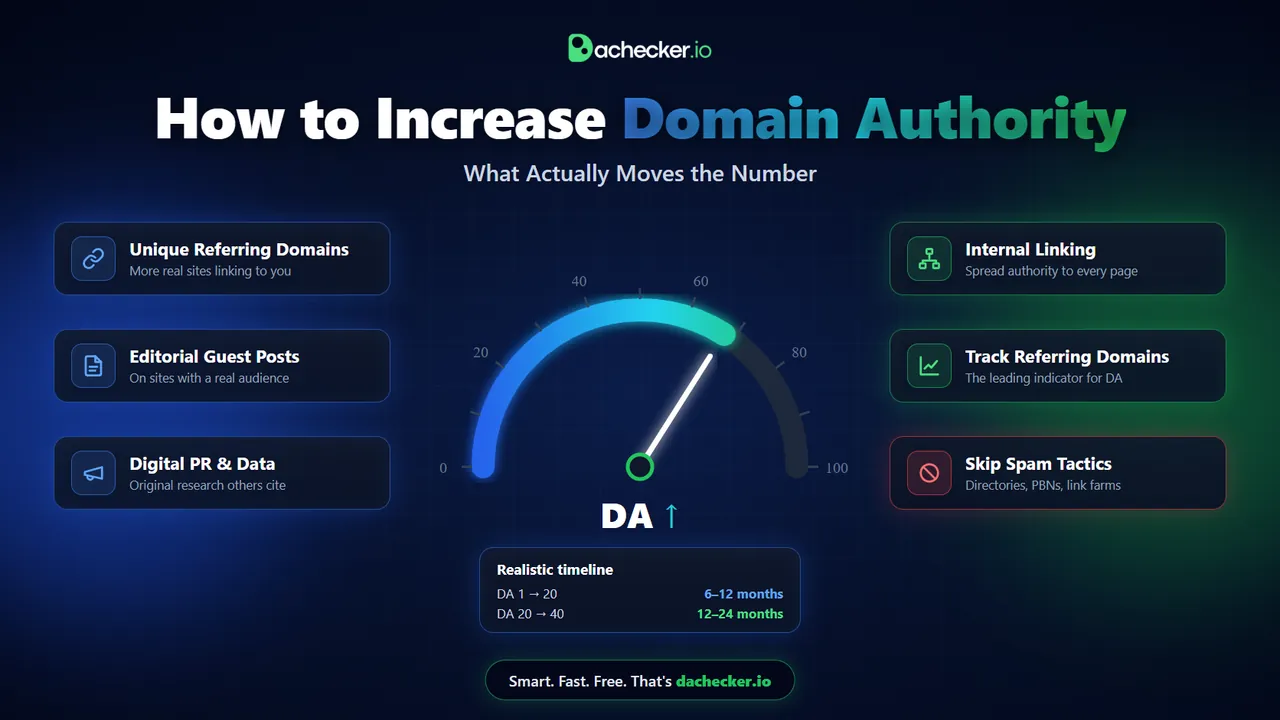
Earn more links from more unique referring domains. That's the core of it. Every other tactic is a variation of this fundamental. The quality of those domains matters — a single link from a DA 65 site in your niche moves your number more than 20 links from DA 5 directories. But volume matters too. Going from 50 referring domains to 500 genuine referring domains is what takes a site from DA 20 to DA 50 over time.
The word "genuine" is doing real work in that sentence. Directory spam, private blog network links, and paid links from link farms can inflate DA temporarily, but Moz's spam detection has improved significantly. And even when questionable links aren't caught immediately, they don't deliver the real-world ranking benefits that make DA worth building in the first place.
Guest Posting: Still the Most Scalable Tactic
Guest posting on legitimate, editorially curated sites remains the most reliable way to build DA at scale. The key phrase is "editorially curated" — the site should have real traffic, a real audience, and standards that make your link genuinely earned. A guest post on a site that publishes anything from anyone isn't worth much. A guest post in a real industry publication that your target audience actually reads is legitimately valuable and contributes meaningfully to your authority profile.
What makes guest posting work is consistency. One or two guest posts a month won't move your DA meaningfully over any sensible timeframe. A sustained campaign — eight to twelve quality placements over six months — starts to show measurable impact. I track referring domain growth in Ahrefs alongside DA scores from the bulk DR checker, because DA sometimes lags a few weeks behind actual link acquisition as Moz's crawler catches up.
Digital PR and Linkable Assets
The highest-leverage link building I've done consistently is publishing original data that journalists and bloggers want to cite. Proprietary surveys, datasets, tools that produce unique outputs, industry reports nobody else has published. When a site puts out a statistic or finding that doesn't exist anywhere else, other publications link to it naturally — because they need to source the claim. Those links come from real editorial decisions, carry high authority, and don't require ongoing cold outreach to maintain.
This takes more upfront investment than guest posting, but the compounding payoff is substantially bigger. I've watched single data-driven pieces earn 50 to 80 referring domains over 12 months without any active promotion after the initial launch. One well-executed linkable asset can do what 40 guest posts accomplish, and it keeps generating links as new writers discover the data through search.
Internal Linking and DA Distribution
Internal links don't directly contribute to Domain Authority, but they matter for how authority flows through your site. If your DA is concentrated on your homepage and a few popular posts, internal links are what distribute that authority to your other pages. A site that earns good external links but never links internally is leaving page-level authority on the table — the benefits accumulate at the entry points and never spread.
I audit internal linking on client sites every quarter. The DA PA checker is useful here for identifying which pages have the most external authority pointed at them — those are the pages whose internal links carry the most weight for distributing equity across the site.
What Doesn't Work Despite What You've Read
Link exchanges in random Facebook groups don't work sustainably. Buying links from mass vendors doesn't work. Submitting your site to 500 free directories doesn't work. Blog commenting doesn't work. Forum signatures don't work. Profile links from random sites don't work. These tactics either have no effect or actively harm your ability to build real authority by diluting your profile with low-quality signals that experienced link evaluators — including Moz's algorithm — can identify.
Sites that build genuine DA over time do it with fewer, better links from sites with real audiences. That's not a shortcut — it requires outreach, relationship building, and content worth linking to. But it's the only path that holds across algorithm updates and index recalculations.
How Long Does It Actually Take
From DA 1 to DA 20 typically takes 6 to 12 months of consistent link building. DA 20 to DA 40 usually takes another 12 to 24 months. Above DA 40, progress slows because you're in territory where your competitors have been building authority for years and the marginal value of each new link is harder to accumulate. I've watched well-run campaigns take a DA 38 site to DA 55 in 18 months — but that required real budget, real content investment, and real relationships with publishers.
Expect non-linear progress. DA often jumps during Moz index updates, then holds flat for weeks even while links are actively being built. Track your referring domain count in a tool like Ahrefs as the leading indicator. Treat DA as the lagging metric that confirms the leading indicator is working. When referring domains grow and DA stays flat, it usually means a Moz update will move it shortly rather than that something is broken.
Common Questions About Raising DA
Can I increase DA without building links? Not meaningfully. Some people see small DA increases after cleaning up toxic links, but that's removing a negative drag, not building a positive. Real DA growth requires real referring domain growth — there's no workaround.
My competitors have DA 60. Can I outrank them with DA 30? Yes, on specific keywords where content depth and relevance outweigh domain-level authority. Long-tail and niche-specific queries are where lower-DA sites find opportunities. You won't outrank a DA 60 site on their core terms until you've closed the authority gap — but you can earn real traffic while you build toward that. To see where their authority comes from, check their backlinks free.
How many referring domains do I need to reach DA 40? Rough benchmark: 200 to 400 quality unique referring domains puts most sites in the DA 35 to 45 range. The actual number depends heavily on the authority of those domains. 100 links from DA 50-plus sites will move your DA more than 500 links from DA 10 sites — quality-to-quantity ratio matters more at every stage than raw link count.
Does social media help DA? No directly. Social shares don't count as backlinks in Moz's index and social signals don't factor into the DA calculation. Social media can help content get discovered, which leads to natural links — that's the legitimate indirect connection. It's real and worth investing in, just not through the mechanism most people assume when they ask the question.
Should I use a link building agency? Depends entirely on how they build links. Ask specifically: what sites do you place links on, can you show me examples, and do those sites have real organic traffic? Any agency that can't or won't answer those questions with specifics is using methods that won't move your DA in a durable way. Use a bulk DR and TF check on their sample sites before signing anything — low Trust Flow on high-DR sites is a classic sign of manipulated metrics.