

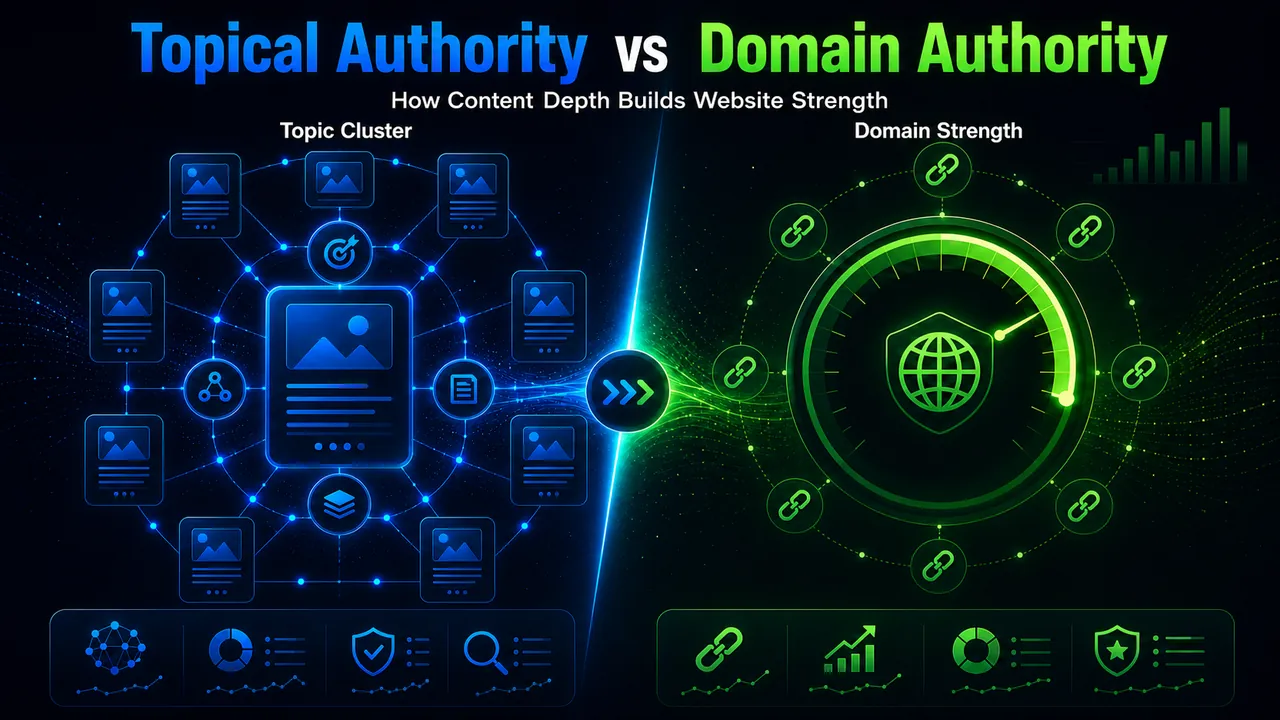
Topical Authority vs Domain Authority: Why Low-DA Sites Keep Outranking You
August 7, 2026
If you've been building DA for two years and a site that launched six months ago keeps outranking you on your core keywords, the explanation is almost always topical authority. It's the part of modern SEO that DA doesn't capture, and it's the reason some of my clients with DA 55 lose consistently to competitors sitting at DA 28. Understanding the difference between the two isn't optional anymore — it's the gap between an SEO strategy that works in 2026 and one that stopped working a few algorithm cycles ago.
What Topical Authority Actually Is
Topical authority is the depth and completeness of your coverage on a specific subject. A site that has published 40 pieces of content covering every angle of Domain Authority — what it is, how it's calculated, how to improve it, how it relates to DR and TF, what it means for local SEO, how anchor text interacts with it — signals to Google that it is a genuine authority on that topic. Not just a site that mentioned the topic once or twice, but a resource that covers the subject completely.
Domain Authority, by contrast, is a domain-wide backlink metric. A site can have high DA by earning links from authoritative sources on many different topics without ever building deep coverage on any single subject. That broad authority is valuable, but it doesn't signal topical expertise the way a comprehensive content cluster does.
Why Google Started Rewarding Topical Depth
Google's Helpful Content updates and the broader shift toward E-E-A-T signals represent a deliberate move away from rewarding pure link authority toward rewarding genuine subject matter expertise. A site that has published one authoritative piece on a topic probably got lucky with a link. A site that has published 30 interconnected pieces on a topic, all coherent, all adding something different, is demonstrating sustained expertise that's harder to fake.
The practical effect is that Google's ranking systems increasingly reward sites that have built a topical map — a structured content plan where a pillar piece covers the main topic at a high level, and spoke articles cover every subtopic, question, and angle a person genuinely interested in that subject would want answered. Sites that execute this well rank for more keywords with lower DA than competitors because they've earned topical trust, not just domain-level link authority.
Real Signals of Topical Authority
Topical authority isn't a single metric you can check the way you check DA. It's inferred from a cluster of signals. The first is content coverage: how many semantically related pieces does a site publish on a topic, and do they link coherently to each other? The second is engagement: do users who find this site's content on a topic stay, read multiple articles, and return? The third is external citation patterns: do other authoritative sources in the same niche reference this site's content specifically on this topic?
A site with genuine topical authority gets cited by topic-relevant sites for its specific expertise, not just as a generic high-DA domain. When a backlink profile shows links from within a tight niche pointing at multiple content pages, that's a topical authority signal that raw DA numbers won't reveal.
How Topical Authority and DA Interact
The two concepts work together, not against each other. A site with both high DA and strong topical authority is nearly unbeatable in its niche. The competition usually lives at the extremes: high DA with shallow topical coverage versus low DA with deep topical coverage. In those matchups, the low-DA topically authoritative site wins specific niche queries while the high-DA broadly authoritative site wins generic queries.
The key implication is that building topical authority in a focused niche generates faster ranking improvements than broad link building without content depth. A site with DA 30 and 35 pieces of tight, interlinked content on a single topic will consistently outperform a DA 30 site with five posts and a fragmented content strategy across unrelated topics.
Building Topical Authority: The Practical Method
The method that works is the pillar-and-spoke model, executed completely rather than partially. Start by mapping every question, subtopic, comparison, and use case relevant to your core topic. Every one becomes a piece of content. The pillar article covers the topic comprehensively. Each spoke covers a single subtopic in the depth it deserves.
The linking structure matters as much as the content itself. Every spoke links up to the pillar using the pillar's target keyword as anchor text. The pillar links down to every spoke. Sibling spokes cross-link where the connection is genuinely useful to a reader. This internal linking architecture tells Google these pages form a coherent topical cluster and distributes link equity from your highest-authority pages to support the rankings of deeper spoke content. The DA and PA data across your pages shows you exactly where authority is concentrated and where internal links should flow from.
How to Measure Topical Authority Progress
Track it through proxy metrics. The first is keyword coverage: are you ranking for a growing number of long-tail variations around your core topic? The second is position movement across related keywords — not just your primary target but the full semantic cluster. The third is organic impressions in Google Search Console for topically related queries you didn't specifically optimize for. When those impressions appear, Google is recognizing your topical relevance.
Track this alongside DA and DR using the bulk DR and TF analyzer to monitor whether link authority is also accumulating as the content cluster matures. Topical authority tends to attract links organically over time — other sites in the niche reference comprehensive content more often than thin content — so the two metrics reinforce each other when the content strategy is working.
The Mistake Most DA-Focused SEOs Make
The most common mistake is treating DA as the strategy rather than the metric. Teams spend their entire SEO budget on link building without a corresponding content investment, end up with decent DA and thin content coverage, and then wonder why rankings aren't improving. The links built real authority, but Google's topical assessment of the site is that it's a generic domain with occasional mentions of a topic — not a genuine resource on it.
The fix is straightforward: build the content cluster first, then let link building reinforce the topical signals the content establishes. A comprehensive content cluster with 25 interlinked pieces on a topic will earn links more naturally than a site with one post and an aggressive outreach campaign, because the cluster is genuinely more linkable. A referring domain growth check after six months of publishing consistently will confirm whether the organic link acquisition rate has increased — it almost always does once topical depth crosses the threshold that other sites in the space recognize as authoritative.
Common Questions About Topical Authority vs DA
Can a site with DA 20 outrank a DA 60 site using topical authority? Yes, on niche-specific queries where the DA 20 site has comprehensive topical coverage and the DA 60 site has thin content on that topic. It happens regularly and is one of the most reliable paths to ranking in competitive niches without the years of link building required to match a high-DA competitor on pure authority alone.
How many articles do I need to build topical authority? There's no fixed number — the threshold is completeness, not volume. A topic with 15 genuinely distinct subtopics needs 15 well-executed articles covering those subtopics, plus a pillar that ties them together. Publishing 40 thin variations of the same angle doesn't build topical authority; it builds a bloated content library that Google will eventually discount.
Does topical authority transfer across topics? Not meaningfully. A site with topical authority in SEO tools doesn't automatically carry that authority into personal finance content. Google's topical signals are specific to the subject matter, not general to the domain. Building authority in a new topic requires the same commitment to comprehensive coverage regardless of your existing DA or topical standing in other areas.
Should I build topical authority before or after building links? Build the content cluster first, then build links to the pillar and strongest spoke pieces. Links pointing at a thin or incomplete cluster don't produce the ranking lift they would on a complete, well-structured cluster. The content is the foundation — links amplify what's already there. Starting with links and planning to add content later produces slower results than the investment deserves.