

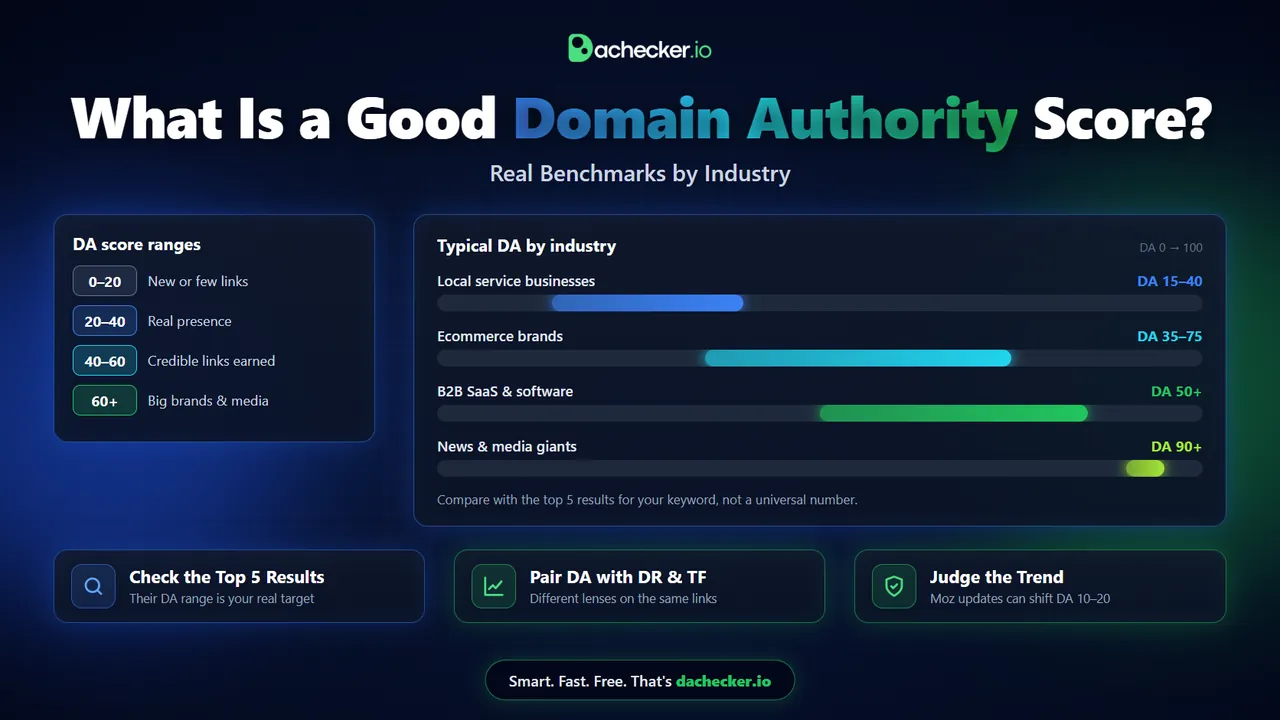
What Is a Good Domain Authority Score? Real Benchmarks by Industry
July 24, 2026
I've been checking Moz Domain Authority scores for clients since the metric was still new enough that most SEOs didn't trust it. Some still don't, and honestly, they have a point. Now I sit across from clients — local business owners, SaaS founders, ecommerce operators — and they all ask the same question: "Is my DA score good?" My answer is always the same: it depends on who you're competing with, not on any universal standard.
The Short Answer Nobody Wants to Hear
There is no universal "good" Domain Authority score. A DA of 22 is outstanding for a three-year-old local law firm. That same DA of 22 is a problem for a B2B SaaS company trying to rank for software keywords. The metric is relative by design. Moz built DA as a comparative tool — it's meant to help you size up your site against competitors in your specific search landscape, not give you an absolute grade on a fixed scale.
That said, benchmarks help people think, so here's a rough starting point from working across industries: sites under DA 20 are generally new or minimally linked. DA 20 to 40 means you've built some real presence. DA 40 to 60 means you've earned meaningful links from credible sources. Above DA 60, you're competing with established media, large publications, or well-funded brands that have been at this for years.
Industry-Specific DA Expectations
Local service businesses — plumbers, dentists, accountants — typically compete in the DA 15 to 40 range. Your city's leading dentist might rank on page one with a DA of 28. Don't compare yourself to national media. Compare yourself to the other three or four results on page one for your actual target keyword in your actual city.
Ecommerce brands operate differently. Product keywords are competitive, and the sites ranking for them often have DA between 35 and 75, depending on the category. If you're selling outdoor gear, you're competing against REI (DA 78), Backcountry (DA 64), and Amazon. That's a categorically different problem than a local HVAC company faces, and it demands a different timeline for building authority.
B2B SaaS and software categories are tough. Most keywords worth ranking for are dominated by sites with DA 50 and above. I've watched well-funded SaaS companies spend 18 months building links, reach DA 42, and still sit on page three. In those categories, DA is table stakes. Content depth, topical coverage, and E-E-A-T signals matter just as much once you've reached competitive territory.
Blogs and affiliate sites can compete at lower DA scores than you'd expect, as long as they're targeting long-tail keywords with genuinely low competition. I've seen DA 18 affiliate sites outrank DA 55 brands on specific product comparison queries. Niche authority and topical depth can outweigh raw domain-level authority when the keyword is specific enough and the higher-DA site hasn't invested heavily in that topic.
News and media outlets play by different rules entirely. Established properties like Forbes (DA 94), The Guardian (DA 92), and HubSpot Blog (DA 90) have link profiles built over decades of operation. If you're a niche publisher, don't aim to outrank them across the board — aim to own specific corners of your topic where their coverage is shallow or outdated.
How to Find the DA You Actually Need
Stop asking what a "good" DA score is in the abstract. Instead, search Google for the keyword you want to rank for, then check the DA of every page in the top five results using dachecker.io's bulk DA PA checker. That number range is your real target. If the results show DA 25 to 40, your DA 30 is competitive. If they show DA 55 to 75, you understand exactly what gap you need to close.
The key insight is that DA is about positioning, not achievement. Two sites with DA 40 are not equally positioned — one might operate in a low-competition niche and rank for hundreds of keywords, while the other is fighting for high-competition terms and winning nothing. The DA number is the same; the competitive reality is completely different.
New Sites and Realistic Early Expectations
If your site is under six months old, your DA is almost certainly below 10. That's normal. Moz's index takes time to crawl your backlink profile, and real backlinks take time to earn. I've taken new sites from DA 1 to DA 25 in 12 months through consistent link building and content — but that requires real effort: guest posts, digital PR, link partnerships with relevant sites, and content worth citing without being asked.
The mistake most site owners make in year one is obsessing over the DA number instead of focusing on the inputs that drive it. Build links from real, relevant sites. Publish content that earns organic citations. Fix your technical SEO so Moz can crawl your full link profile. The DA follows when those inputs are in place — not before.
When DA Stops Being the Right Metric
Domain Authority is a useful proxy, but it has limits. Moz updates its algorithm periodically, and DA can drop 10 to 20 points during a recalculation even if your link profile improved. I've watched clients panic over a DA drop only to find their organic traffic was still climbing. Always pair DA with actual ranking positions and organic traffic data — those are the real outcomes.
For link prospecting, I've started pairing DA with Ahrefs Domain Rating and Majestic Trust Flow, because they measure related but different things. DR is purely about the quantity and quality of referring domains from Ahrefs' dataset; DA incorporates a machine learning prediction layer on top of link signals. Neither is definitively "right" — they're different lenses on the same underlying reality, and disagreements between them often signal something worth investigating.
The Competitor Benchmark Method
The most practical DA-targeting approach I've used is a competitor audit. Pull the DA for your ten closest organic competitors — the sites ranking for five or more of your target keywords. Find the median. That's your six-month target. Find the top quartile. That's your 18-month target.
Running this kind of bulk audit used to mean exporting from multiple paid tools. Now I do most of this work directly in the bulk DR and TF analyzer, then cross-reference with DA scores for a complete picture. The whole thing takes under ten minutes and gives you numbers your clients or stakeholders can understand without a long explanation.
Common Questions About DA Scores
Does a higher DA always mean better Google rankings? No. DA is a predictive metric, not a Google ranking signal. Sites with lower DA outrank higher-DA competitors regularly when their content is more relevant, their page-level signals are stronger, or they've built genuine topical authority in a niche. DA correlates with ranking ability; it doesn't determine it.
Should I try to reach DA 50 before starting link building? That's backwards. You reach DA 50 by building links, not before you start. Begin link building the day your site goes live. Every month you wait is a month of compounding authority you're not building.
My DA dropped from 35 to 28 without any changes on my end. What happened? Moz recalculates DA using a model that accounts for the entire web's link graph. When high-authority sites gain lots of links, relatively speaking, sites that didn't gain links can see their score drop. Check your current DA alongside your referring domain count — if the referring domain count held steady, the drop is likely a recalibration, not a real deterioration.
Is DA 20 good for a new site? For a site under two years old, DA 20 is a healthy early benchmark. It means you've earned real links from real sites. What matters more is whether the sites ranking for your target keywords have DA 20 or DA 60 — that context determines whether DA 20 is competitive or just a starting point.
How fast can DA grow? From DA 1 to 20 can happen in six to twelve months with consistent effort. From DA 20 to 40 usually takes another one to two years. Above DA 50, growth slows significantly because you're competing with sites that have been building authority for years. Progress is real but not linear — DA often jumps during Moz index updates, then holds flat for weeks even while links are actively accumulating.